Sunday, October 31, 2010

Thursday, October 21, 2010
Disappointment and Recovery
Radio waves are everywhere. They surround us at light speed, swarming over the entire earth. The United States broadcasts radio beams into countries it doesn’t like in order to sway the hearts and minds of the inhabitants. A better life, freedom, awaits. Light carries voices. Light carries information. Light is everywhere.
In the last century light has become a technical industry. Governments regulate and control who uses radio for almost every purpose—whether the purpose is recreation, military-related, or simply music. Licensing fees determine who broadcasts what, and to whom, and the process around even getting a license is a mess: one need only read case histories . Political and marketing forces have been instrumental in this determination—and they always will be, for better or worse.
But the technicalization of radio is not an issue here: we are not advocating for an anarchistic free-for-all where radio waves compete by way of power of transmission, or anything else. We are also not concerned with media policy. It is a sad day when cynicism takes over and one ceases to care about making a difference in the world-at-large, when one reconciles the way the world works with the way the world is, or must be. We've reached that point. Media policy no longer concerns us. When nothing is under our control, when the other speaks to us passively, as though in a lecture hall, and never hears our voice specifically, nor needs to, we become cynical. This isn't about free speech. We're not talking about spreading democracy or sticking up for the little guy. Or sticking up for ourselves. We are aware of our own self-loss in something larger. We welcome advocates for anything: good for them. We welcome people gesturing, going out, showing themselves and responding to the world. Those who fight for us, against us, who stand out, are our heroes. But we are not them, and never will be. Our actions, by design, are not heroic. Our own actions, due to reasons that exist at the core of this essay, are not entirely clear, but neither are they irrelevant.
In fact, they are essential.
We need to trace these reasons. What we are looking for is first of all to bring to the forefront a basic situation through description, one which localizes our own actions (see below) while providing the basis for a more general understanding of our basic situation (see conclusion). Our own description of cynicism above isn't technically complete because we haven't yet begun developing our own logic of action, which is different than complete cynicism. We don't distrust everything or everyone, and we don't advocate it. Rather, we find ourselves in a curious position: a position of powerlessness, the ability to act upon others (temporarily?) stripped from us. We blame nobody: we don't blame the government, others, or ourselves. But to face this position is the first step towards something, whatever that something is. This ambiguity is what we must trace, even if only brings us closer to the ambiguity without illuminating it.
I have an AM radio station, which I half-jokingly call RadioTim. It plays in Loring Park, Minneapolis, and on a good sunny day can cover a few good blocks. At night it becomes completely overpowered by other AM stations due to atmospheric conditions. This isn't itself a problem, as probably only a few people have heard my station or would listen to it anyway, but this points out a more pressing issue. Why broadcast if nobody is listening? --If, in fact, by design, it is basically impossible for me to have listeners, as that would require licensing which I am neither willing nor capable?
Recently I began a new project. I bought, borrowed, and set up a bunch of different radios in my apartment and set them all to tune in to RadioTim. Each radio, when I am broadcasting, has its own tone, texture, and tonality. Some are rich in static; some are clear; some are overloaded, and emit an overdrive that is both appealing and appalling. They are located all around my apartment, so my bass can come from one place, guitar from another, and drums from yet another—some radios do better with different sounds (just so happens). So everything is surrounding me, and standing in the middle of my studio apartment with all the perfected volumes is almost overwhelming. Noise is everywhere. Invisible light is converted to audible sound. Everywhere light is, sound is.
I transmit at 1690AM. My own transmission is not explicitly intended politically or as a protest, but it is an action. And a local action is it. I am not responding to the other. I am not speaking my mind to the masses. I am not fighting truth or organizing a community. This is explicitly local.
Sometimes life feels alien: to quote Paul Ricoeur (surprise!):
The first part of this "more" might be a feeling of disappointment. I am disappointed because I cannot change the world and broadcast farther: thus, in a sense, my act is a disappointed act. In being anonymous, if gesturing-outwards is the main method of self-affirmation, then I have lost already. In large part this constitutes the question itself: I can do whatever I like, but if the world does not respond, then my own self degrades and suffers. We must then change tactics. We must recover our disappointed act. This is the course the project has taken, and must take.
Our recovery must take into account the actual description of the event itself: that of listening to RadioTim in my apartment (described above). This in turn, occurs in the context of a radio-marketing complex in which light is transmitted everywhere and surrounds everything, including saturating my apartment and even my body with light I cannot see. I am passive to this light. Nothing can be done except not see, not listen, or not interfere. But I've decided to interfere. In a sense, we could call this a "standing-out," but it would misleading because I'm only "standing-out" to myself. There is no response (or is there? - here is our trace). But this decision is essential. I've chosen something—and here we reach a guidepost in our trace.
I've taken control of 1690AM for my apartment. I've set up my transmitter and I can listen to whatever I want—speeches, music, my own music, my voice, my cat's voice, nothing, mechanical chirps. A simple decision; a rather beautiful outcome, if you would ever care to join me in playing with my radio. It's quite fun.
We now have action, RadioTim. We are not Democracy Now! We are not "The Current" or "MPR."
What our local action has brought to light is the fact that we're deluged with light, everywhere at all times, meant to be turned into sound and language by technology. This light is active-passivity, moving through brick wall after brick wall in order to reach my radios—they are mostly evangelical at 1690AM, but they don't bother me because I enjoy their insanity, and usually a couple different broadcasts overlap at night. An good selection, of course: we can listen to whatever we want. Who cares.
With one switch they are gone, though, overpowered by RadioTim in a specific locality through one local action. How can we think this action? We need to keep on with the ambiguity of our trace. Could we sum up our action as a mere rejection of the public and a forcible exclusion of that same public? Yes, but that misses the point. Our efforts never originally intended that action (we are disappointed this had to be the case). Our recovery has shown that somehow action is key to our thinking. Perhaps it would be better to say that we have now illuminated light by showing that we can act in a local sense—that in the moment of defeat (we are not MPR), we can still act. In doing so, I have become a duality: he who decides and he who acts.
To quote Ricoeur once more:
Thus, our small recovery is underway. Locally, non-politically, therapeutically. Direct local interference in the publicly/privately controlled spectrum of light on a local level has shown us something ambiguous and hard to pinpoint but nonetheless there. I who decide am the I who will do. This locality is something special; a place necessary for all response/responding, and a place necessary for responsibility. A local action, originally intended at others, has shown that others were never actually required for the very presence of responsibility. A duality in the very nature of acting (deciding) provides our own ability to act responsibly. A recovery of a failed intention has provided much more--a trace towards a deep, local, personal responsibility, even if it only means listening and smiling at my own personal radio station.
Come over and listen sometime.
In the last century light has become a technical industry. Governments regulate and control who uses radio for almost every purpose—whether the purpose is recreation, military-related, or simply music. Licensing fees determine who broadcasts what, and to whom, and the process around even getting a license is a mess: one need only read case histories . Political and marketing forces have been instrumental in this determination—and they always will be, for better or worse.
But the technicalization of radio is not an issue here: we are not advocating for an anarchistic free-for-all where radio waves compete by way of power of transmission, or anything else. We are also not concerned with media policy. It is a sad day when cynicism takes over and one ceases to care about making a difference in the world-at-large, when one reconciles the way the world works with the way the world is, or must be. We've reached that point. Media policy no longer concerns us. When nothing is under our control, when the other speaks to us passively, as though in a lecture hall, and never hears our voice specifically, nor needs to, we become cynical. This isn't about free speech. We're not talking about spreading democracy or sticking up for the little guy. Or sticking up for ourselves. We are aware of our own self-loss in something larger. We welcome advocates for anything: good for them. We welcome people gesturing, going out, showing themselves and responding to the world. Those who fight for us, against us, who stand out, are our heroes. But we are not them, and never will be. Our actions, by design, are not heroic. Our own actions, due to reasons that exist at the core of this essay, are not entirely clear, but neither are they irrelevant.
In fact, they are essential.
We need to trace these reasons. What we are looking for is first of all to bring to the forefront a basic situation through description, one which localizes our own actions (see below) while providing the basis for a more general understanding of our basic situation (see conclusion). Our own description of cynicism above isn't technically complete because we haven't yet begun developing our own logic of action, which is different than complete cynicism. We don't distrust everything or everyone, and we don't advocate it. Rather, we find ourselves in a curious position: a position of powerlessness, the ability to act upon others (temporarily?) stripped from us. We blame nobody: we don't blame the government, others, or ourselves. But to face this position is the first step towards something, whatever that something is. This ambiguity is what we must trace, even if only brings us closer to the ambiguity without illuminating it.
* * *
I have an AM radio station, which I half-jokingly call RadioTim. It plays in Loring Park, Minneapolis, and on a good sunny day can cover a few good blocks. At night it becomes completely overpowered by other AM stations due to atmospheric conditions. This isn't itself a problem, as probably only a few people have heard my station or would listen to it anyway, but this points out a more pressing issue. Why broadcast if nobody is listening? --If, in fact, by design, it is basically impossible for me to have listeners, as that would require licensing which I am neither willing nor capable?
Recently I began a new project. I bought, borrowed, and set up a bunch of different radios in my apartment and set them all to tune in to RadioTim. Each radio, when I am broadcasting, has its own tone, texture, and tonality. Some are rich in static; some are clear; some are overloaded, and emit an overdrive that is both appealing and appalling. They are located all around my apartment, so my bass can come from one place, guitar from another, and drums from yet another—some radios do better with different sounds (just so happens). So everything is surrounding me, and standing in the middle of my studio apartment with all the perfected volumes is almost overwhelming. Noise is everywhere. Invisible light is converted to audible sound. Everywhere light is, sound is.
I transmit at 1690AM. My own transmission is not explicitly intended politically or as a protest, but it is an action. And a local action is it. I am not responding to the other. I am not speaking my mind to the masses. I am not fighting truth or organizing a community. This is explicitly local.
Sometimes life feels alien: to quote Paul Ricoeur (surprise!):
"Life with the other might as well be our common dream, our analogous self-loss in the anonymous 'they.' Thus self-affirmation is a gesture of going out, of showing oneself, of bring oneself to the fore and confronting oneself. 'They' do not respond to the question, 'who thinks so, who is making this noise?' because 'they' is no-one. Some one must stand out of the mass in which each—or all—hide. In contrast with the 'one,' I take my act on myself, I assume it….
Now in waking up from anonymity I discover that I have no means of self-affirmation other than my acts themselves. “I” am only an aspect of my acts, the subject pole of my acts. I have no means of affirming myself on the fringes of my acts. This is what the feeling responsibility reveals to me (Freedom and Nature 57).
If the other (in my case, my listeners) helps to define me (as a radiobroadcaster), then what would it mean to have no listeners at all? How is possible to reconcile our own local powerlessness with an awareness of responsibility and self-affirmation? Is the other needed for responsibility, for a recognition of self-affirmation in the first place? Can I play RadioTim only to myself, have nobody listen to it, and leave it at that? Why does it feel like there's something more I need to do here? Ricoeur seems to be placing self-affirmation within action itself and trying to explicitly unlink it from the other. But there's something more involved with my radio. This "more" is a very pressing "more." A radio was meant to be broadcast.
The first part of this "more" might be a feeling of disappointment. I am disappointed because I cannot change the world and broadcast farther: thus, in a sense, my act is a disappointed act. In being anonymous, if gesturing-outwards is the main method of self-affirmation, then I have lost already. In large part this constitutes the question itself: I can do whatever I like, but if the world does not respond, then my own self degrades and suffers. We must then change tactics. We must recover our disappointed act. This is the course the project has taken, and must take.
Our recovery must take into account the actual description of the event itself: that of listening to RadioTim in my apartment (described above). This in turn, occurs in the context of a radio-marketing complex in which light is transmitted everywhere and surrounds everything, including saturating my apartment and even my body with light I cannot see. I am passive to this light. Nothing can be done except not see, not listen, or not interfere. But I've decided to interfere. In a sense, we could call this a "standing-out," but it would misleading because I'm only "standing-out" to myself. There is no response (or is there? - here is our trace). But this decision is essential. I've chosen something—and here we reach a guidepost in our trace.
I've taken control of 1690AM for my apartment. I've set up my transmitter and I can listen to whatever I want—speeches, music, my own music, my voice, my cat's voice, nothing, mechanical chirps. A simple decision; a rather beautiful outcome, if you would ever care to join me in playing with my radio. It's quite fun.
We now have action, RadioTim. We are not Democracy Now! We are not "The Current" or "MPR."
What our local action has brought to light is the fact that we're deluged with light, everywhere at all times, meant to be turned into sound and language by technology. This light is active-passivity, moving through brick wall after brick wall in order to reach my radios—they are mostly evangelical at 1690AM, but they don't bother me because I enjoy their insanity, and usually a couple different broadcasts overlap at night. An good selection, of course: we can listen to whatever we want. Who cares.
With one switch they are gone, though, overpowered by RadioTim in a specific locality through one local action. How can we think this action? We need to keep on with the ambiguity of our trace. Could we sum up our action as a mere rejection of the public and a forcible exclusion of that same public? Yes, but that misses the point. Our efforts never originally intended that action (we are disappointed this had to be the case). Our recovery has shown that somehow action is key to our thinking. Perhaps it would be better to say that we have now illuminated light by showing that we can act in a local sense—that in the moment of defeat (we are not MPR), we can still act. In doing so, I have become a duality: he who decides and he who acts.
To quote Ricoeur once more:
"The duality arising in consciousness is a duality within the very heart of the first person: this is why the subject of the action intended in the project is the same subject who is implicit or explicit in the very act of deciding and intending the project: I who decide am the I who will do (Ricoeur, Freedom and Nature, 47-48).
Thus, our small recovery is underway. Locally, non-politically, therapeutically. Direct local interference in the publicly/privately controlled spectrum of light on a local level has shown us something ambiguous and hard to pinpoint but nonetheless there. I who decide am the I who will do. This locality is something special; a place necessary for all response/responding, and a place necessary for responsibility. A local action, originally intended at others, has shown that others were never actually required for the very presence of responsibility. A duality in the very nature of acting (deciding) provides our own ability to act responsibly. A recovery of a failed intention has provided much more--a trace towards a deep, local, personal responsibility, even if it only means listening and smiling at my own personal radio station.
Come over and listen sometime.
Wednesday, October 20, 2010

Monday, October 18, 2010
Sunday, October 17, 2010
Request-Response


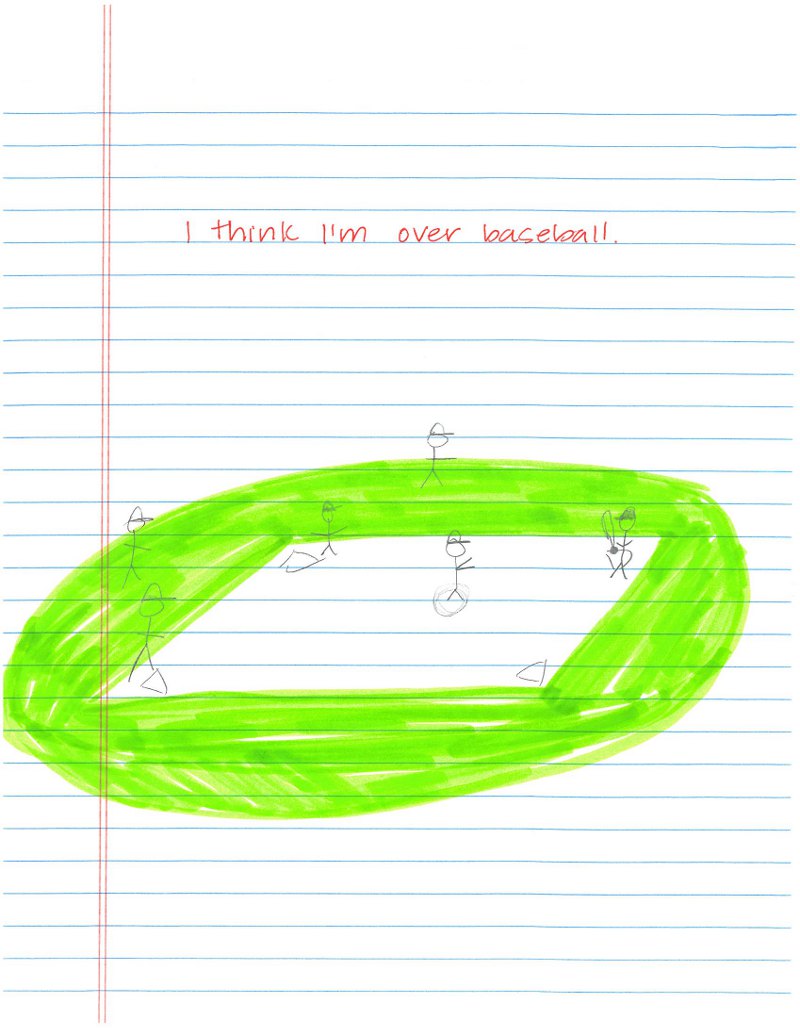
The above came from Ted, via Carrie, on the date referenced on the actual paper itself.

The above came with this submission: I have thought about this long and hard, and this is the picture I am sending you for your art project. I am sending this because of the importance to me of the two people in the picture. I know that sounds corny, but that is the way it is. Received 10/11/10 from Judy.

Saturday, October 16, 2010
Crohn's Log 3
Sorry that I'm complaining, I just didn't feel well today.
I did drop my stool sample off. I had to ask for directions. It's hard to ask "where do I drop my stool sample off" to the 16 year old kid at the information desk. Then some random lady by a random elevator asked me, "Are you the one with the specimen?" and directed me to a random room where you drop poop off. Fun.
Thursday, October 14, 2010
The Dot

1. Decide for yourself to stare at the dot at the center of the work for as long as possible.
2. Stare at the dot, making sure to take note of the fact that you are staring at the dot while you are staring at the dot, and be sure to question why exactly you are staring at the dot—that is, that you decided to stare at the dot.
3. Afterward, think about who decided to stare at the dot (the person perpetually deciding to stare at the dot) and who is carrying out that activity (the actual eyes, body, staring at the dot). Is there a difference between deciding and the actual carrying out of an activity? How does the body enter into this? Is this a command/obey relationship? Question this.
4. Most importantly, if you are constantly deciding to stare at the dot while staring the dot (in effect, making lots of little decisions to stare at the dot adds up to a make-shift larger concept "staring at the dot,"--in effect, leaping from decision to decision) then who is obeying these little decisions to stare at the dot? It would not seem to be the body, but rather some kind of internal will obeying my commands. How does a decision really work? Question this.
...a decision can be considered a command which I give to myself to the extent to which my body appears to me not even as an anonymous mask of an alien force but as the autonomy of a person with its own intentions and its own initiative. Thus I converse with it, and it becomes a second person: "You shake, you old carcass, but if you knew...." Though we may discount the rhetorical aspect which slips into such expressions, we must also admit that self-consciousness carries with it permanently the possibility of such redoubling, of such a dialogue with itself. My relation to myself is like that of a younger and an older brother: I respond for my part like an other who listens, imitates, obeys. In presence of value I sense myself more the younger; in the face of an action in which my body is refractory, I feel more like the elder. This situation is...basic and permanent. To think is to speak to myself, to will is to command myself. In this sense we speak of self-control and use the imperative in second person singular or even plural to express a decision: "Let's go, old man, we've got to get on!"...
But in the end decision is not a true command, only a command by analogy. My body is not another person. The duality arising in consciousness is a duality within the very heart of the first person: this is why the subject of the action intended in the project is the same subject who is implicit or explicit in the very act of deciding and intending the project: I who decide am the I who will do. (Ricoeur, Freedom and Nature, 47-48).
Monday, October 11, 2010
Kabakov
Kabakov challenged the status of paint as “an exception realm of manual mastery” when he pierced a big nail through the surface of a painting call Who Hammered This Nail? (1970)…For the first time in alternative Soviet art these anti-aesthetical works by Kabakov challenged the notion that art has to reflect the sublime and that there is no place in it for the profane….Instead of promoting the idea of action as a sufficient creative gesture, he would ask Moscow artists, poets, and friends to come to a vast, empty country field to blow up balloons, appear and disappear in forest or lie down in a ditch. These “voyagers into nothingness” or “empty actions” served as remedies from urban pressures and identified emptiness as the main characteristic of Soviet existence.
In a different essay:
How do the inhabitants of these places relate to this feeling of emptiness, to this restlessness?
Something like four forms of relations can be distinguished. The first is to attempt, in general, not to notice emptiness with one's consciousness, to live "naturally" in it and to consider all events, causes, and connections of life in emptiness simply "as they are," natural and necessary.
The second is to consider this void-like state unworthy and unacceptable for a person, for human life. In this case, all possible projects and reforms, from economic to legal, are necessary in order to change this place and the living conditions of the local people by a path of construction, displacements, labor, and new reforms.
The third relationship is mystico-religious, according to which this place of emptiness and insecurity is extremely useful for the human soul. Precisely here, in this existence-less place -- the place of "evil, lies, and non-existence" -- it is easier to be save to experience "heaven heights," to search for and find high truth.
The fourth is simply to see this place as it is in face and describe it as a doctor might describe the history of an illness with which he is terminally afflicted.

Thursday, October 7, 2010
Medical Hermeneutics - Soviet Conceptualism
One of this dialogues was translated and published in german, so you can read it, it was about freedom, it is called "contraceptive conversation about freedom". In this dialogue we were discussing one idea of performance. The Performance was: we make big balls of snow in wintertime, then we move with big balls, each man and woman has one ball, [sitting and] holding in a flat in a room, around big table, each has a ball in front of him or her, and then we must speak, only one rule: we do not speak like men, but we have to imagine us to be gods. And in process of speaking, each of participants must observe the process of melting of the snowball. (illustrates) Because: form of ball is absolute form, ideal, at first we identify with this ideal form, in the beginning we are gods, we created our own worlds, like each of us had created the universe. But, because we are sitting in a warm room, the balls will melt and we have to think about this. And speak [about melting]? No, the question is, how this process willl influence our speech. And of course, at the end, when balls are absolutely melted, when we have only dirt in our hands and this uncomfortable feeling in our trousers, we are men, not gods anymore, we have lost our divinity.
We didn`t realize this performance, because thinking about it we deeply meditated about this idea, so it was not neccessary to realize. But the idea of this not realized performance did absolutely influence our work. You can read it in the catalogue of Kunsthalle Düsseldorf, it is a book edited for our exhibition in 1990.

We didn`t realize this performance, because thinking about it we deeply meditated about this idea, so it was not neccessary to realize. But the idea of this not realized performance did absolutely influence our work. You can read it in the catalogue of Kunsthalle Düsseldorf, it is a book edited for our exhibition in 1990.

Saturday, October 2, 2010
Pirate Radio

2. An AM transmitter transmitting RadioTim at 1690AM. Was originally used for real estate.
RadioTim!
Friday, October 1, 2010
Thursday, September 30, 2010
Relief

Monday, September 27, 2010
ROAD KILL
I saw a man drive over a turtle today. I was driving to a breakfast fast-food joint down the street from Shop-At-Home Television and a large turtle, probably larger than a television set, though not a flat screen television set, was walking directly in front of me, crossing the street. Turtles are very slow creatures. I stopped my car, literally stopped my car, and inched around him, making sure not to even get near him, as I have no data on how turtles might move if scared. Maybe they scamper when scared; I don’t know; in any case I inched slowly around him, turning my steering wheel with the utmost caution, and I passed the turtle and almost congratulated myself on passing this turtle, really I felt like patting myself on the back. I dodged a turtle. A vegetarian and a pro-turtle person, I told myself, I can now finally call myself, officially and with all-caps-locked, Pro-Turtle, Pro-Wildlife, Anti-Suburban, Anti-Highway, Anti-Harm, Anti-Death, Pro-Life-In-Some-Generic-Pantheistic-Way. I loved the fucking turtle. I even watched it as I accelerated away from it, happy with myself and seeing it in my rear-view mirror---…--- dot, dot, dot, when, it must be said, I have no words for what comes next, though here it is: a rusted white sedan turned around the bend in the road behind me, and, having plenty of time to stop, plowed directly over the turtle, the turtle going straight under the centerline of the vehicle and emerging behind the car. Though not unscathed. As I said, this turtle was larger than a television set. I couldn’t actually see what happened to the turtle but I did see what happened next. I hit a red light. The white sedan hit a red light. Right next to me. I looked over. There was a passenger, a woman, with her hands covering her face and she was either screaming or laughing--I couldn’t tell, and being rather stunned, I only vaguely remember a few details. I believe I should list these details as an exact description of my state of mind is impossible as I was in some type of shock, some type of stunned silence, terror really, some type of mental incapacitation, maybe a protective fog, its purpose being to protect me from the reality of the situation, and this fog clouded my memory and my thoughts from myself. And so a list is really all I can offer, despite every effort to the contrary.
1. The white sedan had rust surrounding each door.
2. The woman was crying, or laughing, moving back and forth in the passenger seat with her hands covering her face.
3. The man--the driver--was obese.
4. The man had a large arm rested outside the window, and in his hand was a burning cigarette.
5. The man slowly took a drag off this cigarette, nonchalantly, as if nothing had happened.
6. There was no noise.
7. I have no feelings of my own.
The light turned green. He went straight and I turned into the gas station. I was disgusted with everything, really nauseated, and furious. The stunned silence turned to rage against everything: obesity, cigarette smoking, driving, suburbs, myself, my job, highways, roads, cement--everything except turtles and their right to walk across a street without being hit. I was eating breakfast. Eating breakfast was the whole goal of my driving down this suburban street, and I did eat breakfast, but naturally I couldn’t get the turtle out of my head. The worst part --and here we arrive at the crux, the real sizzler, is that I had to pass that very same turtle on the way back. And that turtle was dead. Mutilated. It’s legs had been ripped off; some piece of one of them was lying a few feet away in a bloodied mess. The top of the shell was gone. Replacing it was a reddish pulpy matter. And I could see this reddish pulpy matter sticking up out of the top of this dead turtle’s shell. Whatever organs are at the top of a shell--muscle, I don’t know, I don’t pretend to know but I doubt there are essential organs up at the top of a shell, but whatever this tissue was, was protruding, the top of the shell having been ripped off by the undercarriage of the white sedan. As I said I had to drive passed this mutilated corpse on my way back from breakfast, and my disgust only deepened as I had suspected incorrectly at first that the turtle may have been small enough to emerge unscathed. Obviously I was wrong. This corpse remained there until later in the day, when someone removed all trace of it. Nothing left. The road was empty almost immediately, I assumed. The road kill removal team, I thought, must be quite efficient.
1. The white sedan had rust surrounding each door.
2. The woman was crying, or laughing, moving back and forth in the passenger seat with her hands covering her face.
3. The man--the driver--was obese.
4. The man had a large arm rested outside the window, and in his hand was a burning cigarette.
5. The man slowly took a drag off this cigarette, nonchalantly, as if nothing had happened.
6. There was no noise.
7. I have no feelings of my own.
The light turned green. He went straight and I turned into the gas station. I was disgusted with everything, really nauseated, and furious. The stunned silence turned to rage against everything: obesity, cigarette smoking, driving, suburbs, myself, my job, highways, roads, cement--everything except turtles and their right to walk across a street without being hit. I was eating breakfast. Eating breakfast was the whole goal of my driving down this suburban street, and I did eat breakfast, but naturally I couldn’t get the turtle out of my head. The worst part --and here we arrive at the crux, the real sizzler, is that I had to pass that very same turtle on the way back. And that turtle was dead. Mutilated. It’s legs had been ripped off; some piece of one of them was lying a few feet away in a bloodied mess. The top of the shell was gone. Replacing it was a reddish pulpy matter. And I could see this reddish pulpy matter sticking up out of the top of this dead turtle’s shell. Whatever organs are at the top of a shell--muscle, I don’t know, I don’t pretend to know but I doubt there are essential organs up at the top of a shell, but whatever this tissue was, was protruding, the top of the shell having been ripped off by the undercarriage of the white sedan. As I said I had to drive passed this mutilated corpse on my way back from breakfast, and my disgust only deepened as I had suspected incorrectly at first that the turtle may have been small enough to emerge unscathed. Obviously I was wrong. This corpse remained there until later in the day, when someone removed all trace of it. Nothing left. The road was empty almost immediately, I assumed. The road kill removal team, I thought, must be quite efficient.
Sunday, September 26, 2010
Randomized Trip to Target
Using a random number generator, I generated 5 numbers: 11 29 34 10 18. I then went to these aisles and documented the products on display. I also meandered around a bit too. And bought some things.
Also, YouTube processing sucks. They make things look terrible. Going to stop using it.
Anyway.
Saturday, September 25, 2010
Lines 3 "Angry Lines"

1. Use a random number generator from 1 to 10.
2. Draw generated number of lines (in this case 5), each line shorter than the next. (This group of progressively shorter lines will henceforth be called a "batch.")
3. After drawing the generated number of lines, draw a new batch.
4. Repeat until finished.
Artist: Carrie
Video of my postcards
Quick video of some (not all) of my postcards. There's a bunch more..whole stacks. But who wants to go looking for them.
Thursday, September 23, 2010
Lines 2
Rules:
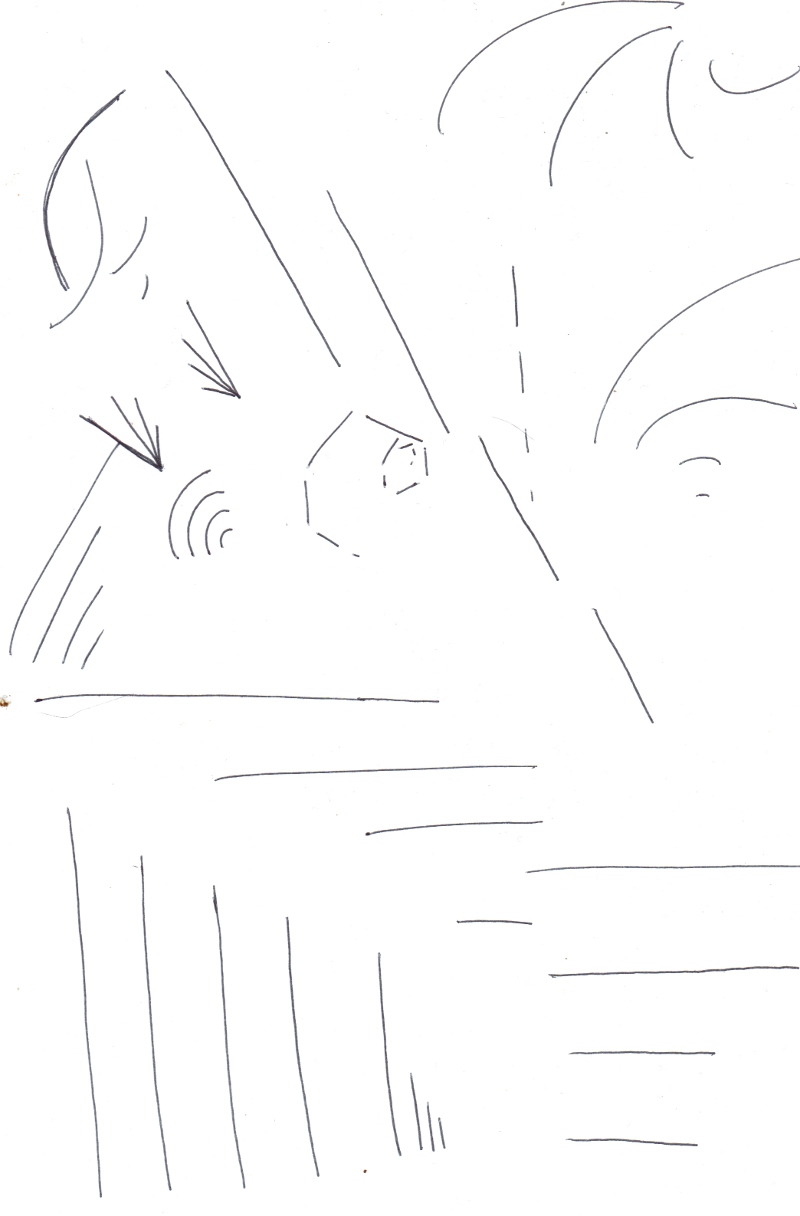
1. Use a random number generator from 1 to 10.2. Draw generated number of lines (in this case 4), each line shorter than the next. (This group of progressively shorter lines will henceforth be called a "batch.")
3. After drawing the generated number of lines, draw a new batch.
4. Repeat until finished.
Artist was Maggie.
Lines 1

1. Use a random number generator from 1 to 10.
2. Draw generated number of lines (in this case 5), each line shorter than the next. (This group of progressively shorter lines will henceforth be called a "batch.")
3. After drawing the generated number of lines, draw a new batch.
4. Repeat until finished.
Wednesday, September 22, 2010
Proclamation
Proclamation:
A new realism.
We don’t want the real.
We don’t want sociology.
We don’t want psychology.
We want exaggeration.
We must understand what we mean by exaggeration.
To exaggerate both means to separate oneself from what actually happened and yet provide the truth of what actually happened as it happened. It is, in fact, a double separation.
First, we must put into words what we wish to tell. The simple act of saying separates us from the actual events; writing itself distances us from the object we must write about. It specifies, directs, points out, brings to bear, forces a description. Writing can classify facts; writing can sanctify. Writing can create worlds, or reflect worlds. Writing is a tool used for many purposes - but we must be clear here. We have a specific purpose.
As Sartre says in Nausea, the big danger in keeping a diary is that you exaggerate everything. We force truth because we’re looking for something. To the narrator of Nausea, this is abominable. Nothing can be exaggerated. The exact nature of his experiences must be spelled out, classified, so as to render them concrete, real. He is not looking for something - though perhaps he actually is, and therein lies the contradiction.
But we have no time for contradictions, we only have time for ourselves and the others around us. We must exaggerate because we must force truth. We, indeed, are looking for something. We must force truth because we wish to create it. We are not looking for reflection. Chronicles do not interest us.
We want creation.
To accept this we must accept that creation involves error, caprice, destruction of facts in order to recapture new facts. We must note what it means to recapture something. Not by a classificatory action of acts, experiences, lists, and so on, but rather by an integration into an act of exaggeration. Exaggeration is our recapturing.
Writing is the first step, as we have said. One which distances us from the subject while also bringing us closer by allowing us to stand back and see the subject as it actually is. Then, we must exaggerate. We must destabilize the living habits we abide by. What previously seemed normal we must make ab-normal. What is ab-normal we must insist upon. Only in this way can we authentically build our lives. We declare that we must separate ourselves from statistics, from definitions, from facts and normality in general - not because we deny them but because we desire something else, something more.
What we desire is search. Questioning. Building. Path-making. Infinite exaggeration, and infinite imagination.
To quote once more, and finally:
Everything here is the path of a responding that examines as it listens. Any path always risks going astray, leading astray. To follow such paths takes practice in going. Practice needs craft. Stay on the path, in genuine need, and learn the craft of thinking, unswerving, yet erring. (Heidegger)
A new realism.
We don’t want the real.
We don’t want sociology.
We don’t want psychology.
We want exaggeration.
We must understand what we mean by exaggeration.
To exaggerate both means to separate oneself from what actually happened and yet provide the truth of what actually happened as it happened. It is, in fact, a double separation.
First, we must put into words what we wish to tell. The simple act of saying separates us from the actual events; writing itself distances us from the object we must write about. It specifies, directs, points out, brings to bear, forces a description. Writing can classify facts; writing can sanctify. Writing can create worlds, or reflect worlds. Writing is a tool used for many purposes - but we must be clear here. We have a specific purpose.
As Sartre says in Nausea, the big danger in keeping a diary is that you exaggerate everything. We force truth because we’re looking for something. To the narrator of Nausea, this is abominable. Nothing can be exaggerated. The exact nature of his experiences must be spelled out, classified, so as to render them concrete, real. He is not looking for something - though perhaps he actually is, and therein lies the contradiction.
But we have no time for contradictions, we only have time for ourselves and the others around us. We must exaggerate because we must force truth. We, indeed, are looking for something. We must force truth because we wish to create it. We are not looking for reflection. Chronicles do not interest us.
We want creation.
To accept this we must accept that creation involves error, caprice, destruction of facts in order to recapture new facts. We must note what it means to recapture something. Not by a classificatory action of acts, experiences, lists, and so on, but rather by an integration into an act of exaggeration. Exaggeration is our recapturing.
Writing is the first step, as we have said. One which distances us from the subject while also bringing us closer by allowing us to stand back and see the subject as it actually is. Then, we must exaggerate. We must destabilize the living habits we abide by. What previously seemed normal we must make ab-normal. What is ab-normal we must insist upon. Only in this way can we authentically build our lives. We declare that we must separate ourselves from statistics, from definitions, from facts and normality in general - not because we deny them but because we desire something else, something more.
What we desire is search. Questioning. Building. Path-making. Infinite exaggeration, and infinite imagination.
To quote once more, and finally:
Everything here is the path of a responding that examines as it listens. Any path always risks going astray, leading astray. To follow such paths takes practice in going. Practice needs craft. Stay on the path, in genuine need, and learn the craft of thinking, unswerving, yet erring. (Heidegger)
Randomized Lohan Report
"Bailiffs handcuffed Lohan immediately after the hearing that lasted less than ten minutes at the Beverly Hills courthouse."
"10 17 6 14 16 4 1 12 3 8 5 15 18 2 11 9 13 7" is random sequence used to translate this sentence. Each word was assigned a number, randomly assigned into a new order according to the sequence, then rearranged into the following sentence.
"less hills the at Beverly immediately Bailiffs ten Lohan that after the courthouse. handcuffed than lasted minutes hearing"
"10 17 6 14 16 4 1 12 3 8 5 15 18 2 11 9 13 7" is random sequence used to translate this sentence. Each word was assigned a number, randomly assigned into a new order according to the sequence, then rearranged into the following sentence.
"less hills the at Beverly immediately Bailiffs ten Lohan that after the courthouse. handcuffed than lasted minutes hearing"
Randomized Robert Frost
The long the chance chance head with its human head remotest head race head not chance race with I'm its I'm pace going much the is unnoticed of that much longer keeping.
Tuesday, September 21, 2010
A Different Version
This is not a parable.
And there was a second
When I thought a thought
Going somewhere quite new.
I must have been joking:
I knew it an impasse
Though the thought I followed
Was a thought so very new-
But my train was derailed
Its engine giving up
And crashing to a halt.
And there was a second
When I thought a thought
Going somewhere quite new.
I must have been joking:
I knew it an impasse
Though the thought I followed
Was a thought so very new-
But my train was derailed
Its engine giving up
And crashing to a halt.
Friday, February 19, 2010

Saturday, February 13, 2010
"The 'Theory of Art' as Packaging Control and the History of Error in Developed Economies"
In this essay I will never complete I will write about things I will never think about, let alone write about. Whatever may be said against or for this method, one thing is essential: whenever talented people approach art with the sole idea of serving it sincerely to the utmost measure of their ability, the result is always gratifying. We quote Victor Terras quoting the great Mayakovsky:
"'I've been run over by time!'"We may also be tempted to quote Victor Terras quoting Ivanov:
"...wanted to pray, but could not...having checked if the noose would hold, flung himself into darkness...[the suicide's last thoughts belong] not to what makes this earth beautiful, but to a dirty Moscow Tavern, A Candle Stump, A Corridor, Two White Zeroes On A Door."We were tempted solely by the gratification afforded us by these looming talents. The second sentence of this non-essay is an unmarked quote.
page 66 old man and the sea
The thousand times that he had proved it meant nothing. Now he was proving it again. Each time was a new time and he never thought about the past when he was doing it. Life on the edge can be rough around.
I wish he'd sleep and I could sleep and dream about the lions, he thought admirably. Life is a texture. Why are the lions the main thing that is left? Why am I wondering this? Who is wondering about myself wondering about lions if not myself? Are there two people inside of me? Don't think, old man, he said to himself. There must be two people inside me. Look: I just said something to myself. It's a fact. I proved it again. Rest gently now against the wood and think of nothing. He is working. Work as little as you can. Never work. Never work. Who is thinking "never work?" Is it strange that I am telling myself to not think? Who is inside me commanding and who is inside me obeying? And who the hell is this person thinking about commanding and obeying? How many people are there inside me? How is it that I do anything and what the hell am I anyway? I think this fish must be damn smart. Never work. He is working. I must not work. Who is it who is telling me to not work? I was right when I called myself a "strange old man" two paragraphs up.
Subscribe to:
Posts (Atom)