Showing posts with label art. Show all posts

Tuesday, November 16, 2010

Scenes from the Future: Komar and Melamid

Western Modernism and Russian Stalinism were projects that demanded a denial of the past, a constant movement towards an ideal future. But the past cannot be denied. Like the repressed it always returns…


It is against this somber background Komar and Melamid’s penchant for parody and irony should be seen. It is a device, a way of combating the sense of tragedy. They quote Kierkegaard: “In irony, the subject is negatively free, free from the shackles which in reality restrain him so firmly.” Irony provides a provisional release from tragedy. At the same time it eats away at rhetoric, hypocrisy, and idealization. It corrodes myths, old and new. In his brilliant and path-breaking essay from the late fifties, “On Socialist Realism,” Sinyavsky wrote that “irony is the laughter of the superfluous man who derides himself and everything sacred in the world. Irony is the faithful companion of unbelief and doubt: it vanishes as soon as there appears a faith that does not tolerate sacrilege”—whether, it might be added, that faith is in Stalinism, Old Russia, or free market Westernization. Irony may provide only a “negative freedom,” yet this peculiarly “accursed” Russian irony, this “disorder of the soul,”…is still the only passage out from an epoch of half-measures and half-truths, from a present mortgage to an imaginary future and a future dragged back by the weight of the past. There are no new miracles or new truths to be spun out of new dreams and new delusions. It is better to start the future over with the wormwood and the rust.

by Peter Wollen
 

Isn't it nice that irony finally gets the respect it deserves?  Am I being ironic?  What's cool is that even though this essay is talking about some Russian artists who came to America and how they functioned here, and it specifically mentions how they are dealing with Russia's past, it really works the same way with us here...I'll repeat what I already quoted to make the point:

Irony may provide only a “negative freedom,” yet this peculiarly “accursed” Russian irony, this “disorder of the soul,”…is still the only passage out from an epoch of half-measures and half-truths, from a present mortgage to an imaginary future and a future dragged back by the weight of the past. There are no new miracles or new truths to be spun out of new dreams and new delusions. It is better to start the future over with the wormwood and the rust.

What better description of our present could there be?  Seems particularly timely.

Tuesday, November 9, 2010

INSECURITY

Every loss of confidence is ultimately a step towards death. A step towards indecision. A step towards incapacitating, bedridden reflection. I think this as I stare at my newest painting, The Dot, which is a painting of a small black dot in the center of a rectangular piece of blue paper. I framed it and hung it on my wall and now I'm standing in front of it, staring at it, trying desperately to remember the instructions that go with the painting. There are instructions for looking at this painting but they are only written somewhere else, somewhere I can't find right now, so I'm half-making them up even though they were very specific, specifically designed to bring to light something cold and dark, something that we never think about. Something that is deep within us. A secret. It actually works. (I think.) But I can't find the damn instructions so I'm just staring at this damn dot. I've lost all confidence in this work and all my work as I stare at this dot, I think, I have no confidence in anything anymore. Not only have I lost all confidence but now I'm even telling myself that I've lost all confidence, and this can't be a good sign. It's one thing to just lose all your confidence; it's another to tell yourself that you're nothing, that you're finished, done, dead. In the first case at least you still have your pathetic self; in the second case you've lost even your pathetic self and created this commentator second-self, and this second self is standing there behind your first self laughing at the first's own inability and insecurity. But really you're performing both parts like a bad stage play. I think this while staring at the dot. I start to wonder what people think about while looking at paintings. Do they interpret them? Where are my instructions for this damn dot, I think to myself, these damn instructions need to be posted with the painting—I really don't understand why I didn't post them right up here next to the painting. I've lost my confidence, and while I was going to try to get some work done today now I realize that it's impossible, that I've lost all my confidence and that I'm slipping towards death, towards total incapacitation, which is really the same thing as death. The Dot, in fact, is precisely about this, I think, clicking my tongue and letting my eyes wander from the dot (but then quickly forcing them back to the dot in the center of the blue rectangle). The Dot was supposed to be about deciding to stare at the dot, telling yourself to stare at the dot, and thereby becoming aware that you are telling yourself to stare at the dot. I believe that this was what it was about. I've decided to stare at the dot. Now, who is staring at the dot? I am. There's the blue rectangle and there's the black dot in the middle. I'm staring at the dot. But now that I'm staring at the dot and now that I'm aware that I'm staring at the dot, who is giving the command to stare at the dot? I'm staring at the dot but somehow this second-self still seems to be there, commanding me to stare at the dot, but really I'm this second-self too, commanding myself to stare at the dot. The second self isn't laughing anymore. My eyes are darting and I'm being distracted but something is being dredged up from inside me. The dot is misshapen, I think, I didn't draw it very well with my sharpie, I think—but instantly I stop this line of thinking as I can't let myself be distracted by the aesthetic aspects of the work. The work is more important for it's phenomenological import. So I'm staring at this dot, and I've split myself into at least two people: he who commands and he who obeys. Yes! This is The Dot, I think. This is what I was supposed to realize, I think. My second-self is really myself, as is my first self, but this duality is deeply rooted and my two selves are inseparable. Any loss of confidence, I now think, would have to take into account this indivisible duality. Or at least think it through, and I will think it through, right now. Insecurity, indecision, and even bedridden reflection need to be reminded of my ability to act through my meditation on The Dot. Even if The Dot is not a major action (it is in fact a simple action), and even if it's an arbitrary action, we can see that The Dot can remind us of our ability to do in the face of insecurity, incapacitation, and bedridden reflection. I stare because I believe in my ability to do at all (because of my indivisible duality, which commands and obeys—but this command/obey relationship is really only metaphoric, we have to remind ourselves), I think, and my act proves my ability. The Dot is a savior. I must remind my loss of confidence that I can still act, that even though I feel my loss of confidence deeply, that I can still act, that even though I've basically become metaphorically bedridden (temporarily) due to my inflamed bowel, that I can still act. I think all this while staring at The Dot. I wonder where those instructions went. They must be somewhere. But then I wonder if I need them at all, or if I just needed to be reminded to listen to The Dot. What do people think when they look at paintings, I think again. Would anyone else have acted upon this painting in this way without a signpost pointing him or her in the right direction? Those instructions must be somewhere. I'll have to find them. I need to find them because I need to be reminded to actually listen, to be receptive. And I will find them. And I'll share them without anyone who needs to be reminded.

Thursday, November 4, 2010

How to Decorate an Apartment


You see, the point is to stare at the frame on the wall and wonder about what goes in it.  (Or why we frame pictures and things and put them on our walls to begin with.)  If you'd like, you can imagine something for my apartment, or what you'd like in your own apartment.  Sit and stare and imagine for a while and I promise this will do you well.

Thursday, October 14, 2010

The Dot


1. Decide for yourself to stare at the dot at the center of the work for as long as possible.

2. Stare at the dot, making sure to take note of the fact that you are staring at the dot while you are staring at the dot, and be sure to question why exactly you are staring at the dot—that is, that you decided to stare at the dot.

3. Afterward, think about who decided to stare at the dot (the person perpetually deciding to stare at the dot) and who is carrying out that activity (the actual eyes, body, staring at the dot). Is there a difference between deciding and the actual carrying out of an activity? How does the body enter into this? Is this a command/obey relationship? Question this.

4. Most importantly, if you are constantly deciding to stare at the dot while staring the dot (in effect, making lots of little decisions to stare at the dot adds up to a make-shift larger concept "staring at the dot,"--in effect, leaping from decision to decision) then who is obeying these little decisions to stare at the dot? It would not seem to be the body, but rather some kind of internal will obeying my commands. How does a decision really work? Question this.

...a decision can be considered a command which I give to myself to the extent to which my body appears to me not even as an anonymous mask of an alien force but as the autonomy of a person with its own intentions and its own initiative. Thus I converse with it, and it becomes a second person: "You shake, you old carcass, but if you knew...." Though we may discount the rhetorical aspect which slips into such expressions, we must also admit that self-consciousness carries with it permanently the possibility of such redoubling, of such a dialogue with itself. My relation to myself is like that of a younger and an older brother: I respond for my part like an other who listens, imitates, obeys. In presence of value I sense myself more the younger; in the face of an action in which my body is refractory, I feel more like the elder. This situation is...basic and permanent. To think is to speak to myself, to will is to command myself. In this sense we speak of self-control and use the imperative in second person singular or even plural to express a decision: "Let's go, old man, we've got to get on!"...
But in the end decision is not a true command, only a command by analogy. My body is not another person. The duality arising in consciousness is a duality within the very heart of the first person: this is why the subject of the action intended in the project is the same subject who is implicit or explicit in the very act of deciding and intending the project: I who decide am the I who will do. (Ricoeur, Freedom and Nature, 47-48).

Monday, October 11, 2010

Kabakov

Kabakov challenged the status of paint as “an exception realm of manual mastery” when he pierced a big nail through the surface of a painting call Who Hammered This Nail? (1970)…For the first time in alternative Soviet art these anti-aesthetical works by Kabakov challenged the notion that art has to reflect the sublime and that there is no place in it for the profane….Instead of promoting the idea of action as a sufficient creative gesture, he would ask Moscow artists, poets, and friends to come to a vast, empty country field to blow up balloons, appear and disappear in forest or lie down in a ditch.  These “voyagers into nothingness” or “empty actions” served as remedies from urban pressures and identified emptiness as the main characteristic of Soviet existence.

In a different essay:

How do the inhabitants of these places relate to this feeling of emptiness, to this restlessness?

Something like four forms of relations can be distinguished.  The first is to attempt, in general, not to notice emptiness with one's consciousness, to live "naturally" in it and to consider all events, causes, and connections of life in emptiness simply "as they are," natural and necessary.

The second is to consider this void-like state unworthy and unacceptable for a person, for human life.  In this case, all possible projects and reforms, from economic to legal, are necessary in order to change this place and the living conditions of the local people by a path of construction, displacements, labor, and new reforms.

The third relationship is mystico-religious, according to which this place of emptiness and insecurity is extremely useful for the human soul.  Precisely here, in this existence-less place -- the place of "evil, lies, and non-existence" -- it is easier to be save to experience "heaven heights," to search for and find high truth.

The fourth is simply to see this place as it is in face and describe it as a doctor might describe the history of an illness with which he is terminally afflicted.


Thursday, October 7, 2010

Medical Hermeneutics - Soviet Conceptualism

One of this dialogues was translated and published in german, so you can read it, it was about freedom, it is called "contraceptive conversation about freedom". In this dialogue we were discussing one idea of performance. The Performance was: we make big balls of snow in wintertime, then we move with big balls, each man and woman has one ball, [sitting and] holding in a flat in a room, around big table, each has a ball in front of him or her, and then we must speak, only one rule: we do not speak like men, but we have to imagine us to be gods. And in process of speaking, each of participants must observe the process of melting of the snowball. (illustrates) Because: form of ball is absolute form, ideal, at first we identify with this ideal form, in the beginning we are gods, we created our own worlds, like each of us had created the universe. But, because we are sitting in a warm room, the balls will melt and we have to think about this. And speak [about melting]? No, the question is, how this process willl influence our speech. And of course, at the end, when balls are absolutely melted, when we have only dirt in our hands and this uncomfortable feeling in our trousers, we are men, not gods anymore, we have lost our divinity.

We didn`t realize this performance, because thinking about it we deeply meditated about this idea, so it was not neccessary to realize. But the idea of this not realized performance did absolutely influence our work. You can read it in the catalogue of Kunsthalle Düsseldorf, it is a book edited for our exhibition in 1990.


Thursday, September 30, 2010

Relief

But habit is a double-edged tool which also presents a temptation and an opportunity for a degradation of active willing.  Its spontaneity is also an inertia: the weak or tired will sees in its easy, readily available pattern not just a tool for effective action but also a relief from responsibility, a substitute for such action.  Thus the ultimate significance of habit--as well as preformed skills and emotion--depends on the effort which determines whether the will uses them or yields to them.

Saturday, September 25, 2010

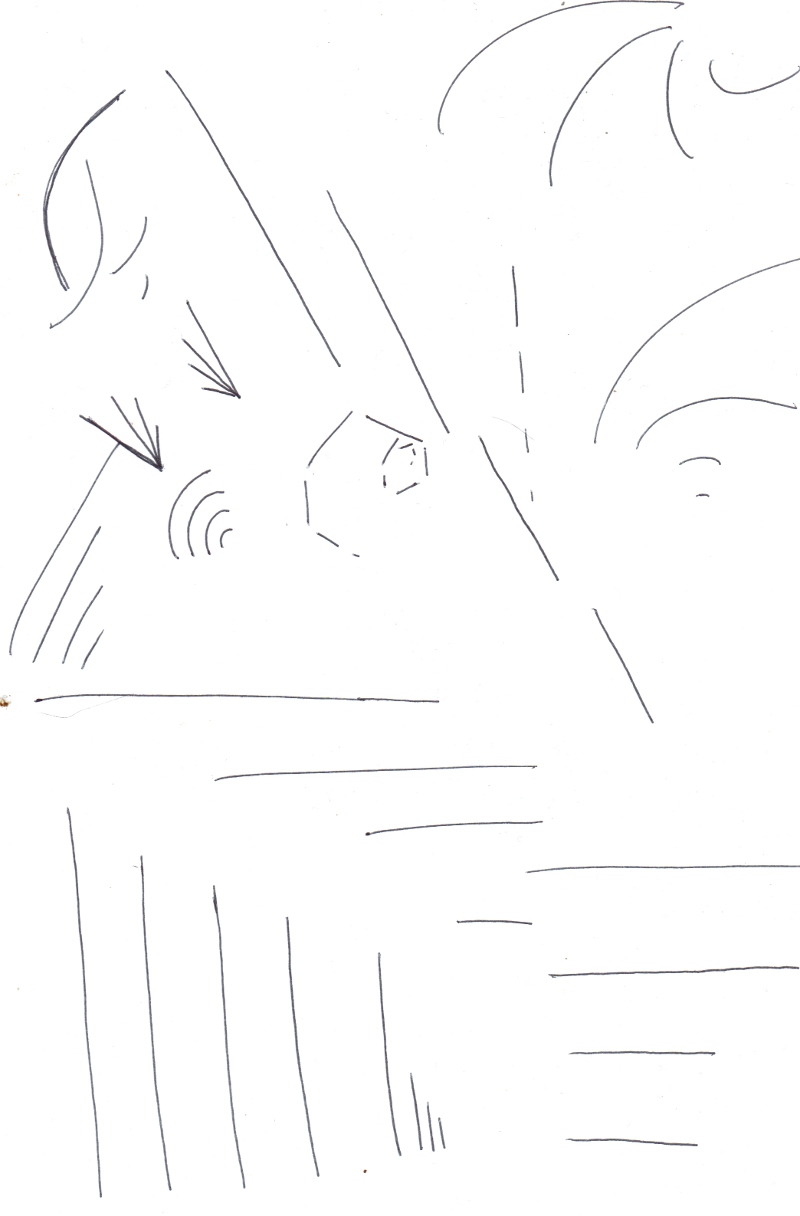
Lines 3 "Angry Lines"

Rules:
1.  Use a random number generator from 1 to 10.
2.  Draw generated number of lines (in this case 5), each line shorter than the next.  (This group of progressively shorter lines will henceforth be called a "batch.")
3.  After drawing the generated number of lines, draw a new batch.
4.  Repeat until finished.

Artist: Carrie

Thursday, September 23, 2010

Lines 2


Rules:
1.  Use a random number generator from 1 to 10.
2.  Draw generated number of lines (in this case 4), each line shorter than the next.  (This group of progressively shorter lines will henceforth be called a "batch.")
3.  After drawing the generated number of lines, draw a new batch.
4.  Repeat until finished.

Artist was Maggie.

Lines 1

Rules:
1.  Use a random number generator from 1 to 10.
2.  Draw generated number of lines (in this case 5), each line shorter than the next.  (This group of progressively shorter lines will henceforth be called a "batch.")
3.  After drawing the generated number of lines, draw a new batch.
4.  Repeat until finished.

Thursday, February 4, 2010

Quarter Art from Sister Carrie Mary Clarence and ME looking like I have something stupid to say in philadelphia.

Rules:

1. send a postcard to tim with tim on it.  Don't actually send it.  Just leave it here in Minneapolis and he'll find it at some point.
2. draw quarters on back, using quarters as guide, eyes open
3. love your brother just like philly pride states.

Thursday, January 28, 2010

DOLLAR BILL

Rules:

1.  Five minutes to draw a dollar with closed eyes.
2.  It has to be accurate to some extent.
3.  What?

ORAGAMI


The kids damn near loved it at free arts.

Thursday, January 14, 2010

HOW TO USE ART. THANKS CONOCO GAS STATION.


Proud owner of number 2, by the way.